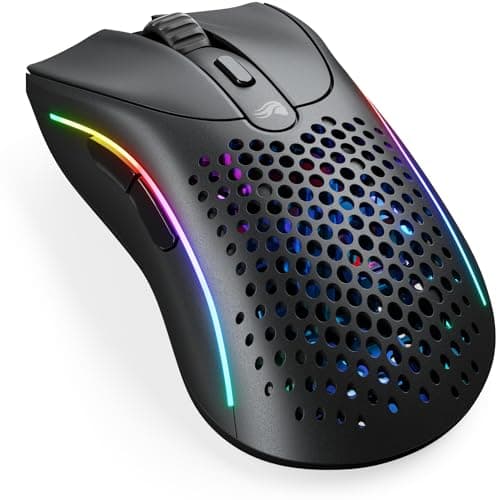
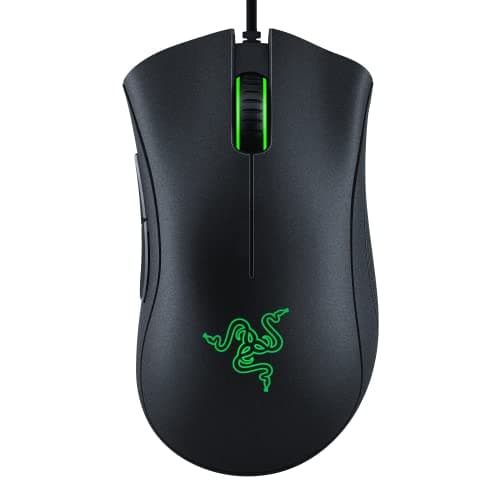
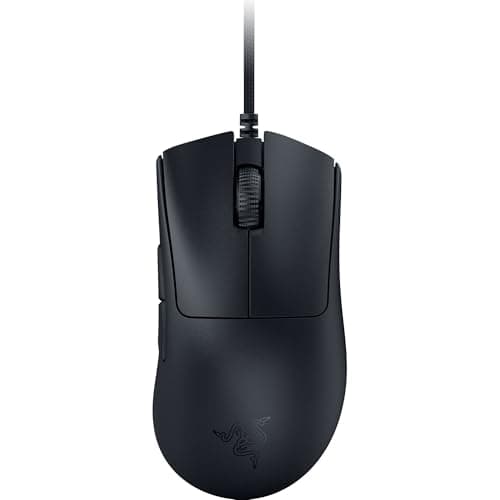
Buy the Razer DeathAdder V3. Razer publishes it at 128 x 68 x 44 mm and 59 g, and that 44 mm of height is the specification that actually decides whether a mouse fits a large hand — far more than the length everyone quotes. If you need it wireless, the Glorious Model D 2 Wireless is the same idea at 127 mm and 66 g.
Big hands have had a worse decade than small ones. The competitive mouse market spent it chasing weight, and the fastest way to remove weight from a mouse is to remove shell — so the models that reviewers rank highest got shorter and, more importantly, flatter. A lot of the mice currently described as the best in the world are 120 mm long and 38 mm high, which is a superb tool if your hand is 17 cm and a cramp machine if it is 20 cm.
Worse, “large” is not a regulated word. Manufacturers apply it to anything above their own median, which is why two mice both marketed to big hands can differ by a centimeter of length and five millimeters of height. The only defense is to read the published dimensions, and that is what this page is built on: every mouse here is listed with the figures its own manufacturer publishes, or with an independently measured figure attributed to the lab that measured it. We have not measured a mouse ourselves and we are not going to imply we have.
Measure your hand first. It takes thirty seconds
Two numbers, and you only need a tape measure and a flat surface.
- Length. From the crease at the base of your palm to the tip of your middle finger, with the hand flat and the fingers extended.
- Width. Across your knuckles, excluding the thumb, with the hand flat.
The commonly used rule of thumb puts anything from about 19 cm of length upward in “large” territory, and above about 20 cm you are in the group this page is for. Treat that as a rough guide rather than a standard, because no standard exists — different brands draw the line in different places, and width matters nearly as much as length for whether your thumb and little finger have anywhere to sit.
The number that then does the work is height, not length. A mouse supports a palm grip only if the hump is tall enough to fill the arch of your hand; if it is not, your palm bridges over it and your weight lands on the heel of your hand on the mousepad. That is the exact mechanism behind “this mouse is long enough but it still feels small”, and it is why we lead with the DeathAdder V3's 44 mm rather than its 128 mm.
Your grip style changes the target too, and it is worth knowing which one you actually use before you shop — our mouse grip styles explained guide walks through identifying it. Palm grip wants the most shell and the tallest hump. Claw grip wants length and height but a narrower waist to pinch. Fingertip grip, counter-intuitively, wants a smaller mouse even on a large hand, because you are steering it with your fingers rather than resting on it. A large-handed fingertip player is one of the few people who should ignore this page and read our best lightweight gaming mice page instead.
The naming trap: same model, different shell
This catches people out constantly and it costs a return, so it is worth its own section. A model name plus a suffix does not guarantee the same physical shape.
The clearest current example is the DeathAdder. Razer publishes the wired DeathAdder V3 at 128 x 68 x 44 mm. Razer publishes the wireless DeathAdder V3 HyperSpeedat 122.2 x 64.8 x 41.3 mm. Those are not the same mouse with a radio added — the HyperSpeed is nearly 6 mm shorter and 3 mm lower, which moves it out of the large bracket entirely. If you buy it expecting the shape in our top pick because the names look adjacent, you will be disappointed, and the listing will not warn you.
The same applies across brands and across generations: a “Pro” or “Wireless” version is frequently a different mold, and a V2 is often smaller than the V1 it replaced because the market moved toward lighter mice. Check the published dimensions on the exact variant you are adding to your basket, every time. Where a manufacturer does not publish them, RTINGSmeasures the physical dimensions of most popular mice independently — its measured lengths are what we used for the two older mice on this page, the Basilisk V3 and the DeathAdder Essential, both of which it puts at roughly 130 mm and 128 mm respectively.
Weight: the trade-off is real, and it is smaller than it was
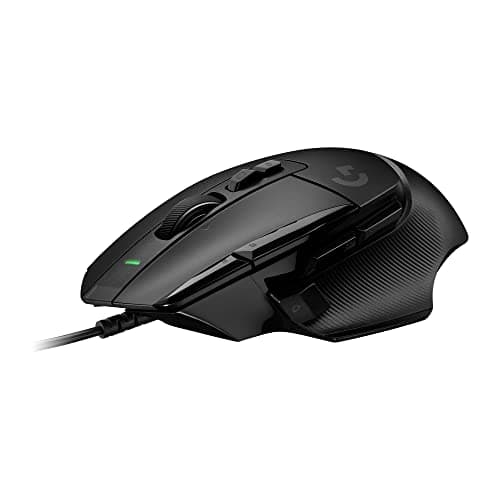
Large shells used to mean heavy mice, because more plastic weighs more and the big-hand models were also the feature-heavy ones. The G502 HERO at 121 g and the Basilisk V3 at 101 g are both from that era, and both are still perfectly good mice.
What changed is that honeycomb shells and better internals brought full-size mice down to where the small ones were. The DeathAdder V3 is 128 mm and 59 g. The Model D 2 Wireless is 127 mm and 66 g, wirelessly. Five years ago neither existed, and a big-handed player who wanted a light mouse had to accept one that was too small for them. That is no longer the trade, which is the main reason this page is worth writing in 2026 and would have been a shorter page in 2021.
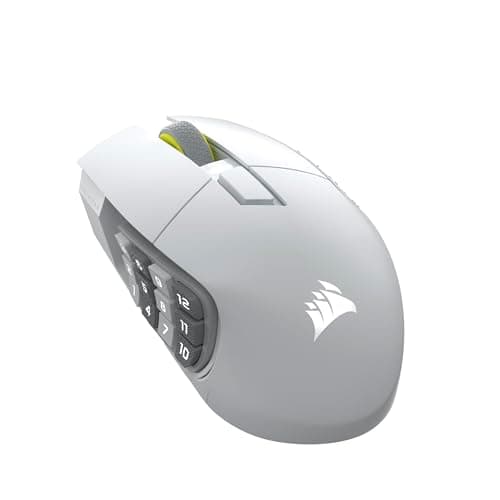
Whether you should chase the low number at all depends on what you play. In a shooter where you flick, mass is work your arm has to do thousands of times a session, and the lighter mouse is measurably easier to move precisely. In an MMO, a strategy game or anything where the mouse mostly glides and clicks, a heavier mouse feels more planted and the weight is close to irrelevant — which is why we have the 114 g Scimitar on this page without apology. Our lightweight vs heavy gaming mouse guide goes through that properly.
The desk matters as much as the mouse
Two things that a large hand makes more important, and both are cheaper than a new mouse.
Mousepad area. A bigger hand on a bigger mouse at a low sensitivity sweeps a wider arc, and running out of pad mid-flick is the most common cause of inconsistent aim that has nothing to do with your hardware. If your mouse leaves the pad during a 180, the pad is the problem. Our what size mousepad do I need guide has the arc math, and best gaming mousepads covers the surfaces.
Armrest and desk height.A neutral wrist — forearm roughly level, wrist not bent up or sideways — is what OSHA's workstation guidance asks for, and it is harder to achieve with long forearms on a desk set for an average one. If your elbows are below the desk surface, you will bend your wrist up to reach the mouse, and no shell shape compensates for that. Armrests set to desk height fix it, which is why we ranked chairs on armrest adjustability in our best gaming chairs under $200page — it is the companion purchase to this one for a larger player.
How to choose between these six
If you play shooters and you grip with your palm, buy the DeathAdder V3. It is the tallest and one of the longest shells here, at a weight that would have been flagship territory recently, and the only reason not to is that it is wired.
If it has to be wireless, the Glorious Model D 2 Wirelessis the direct equivalent — 127 mm, 66 g, dual-mode, and a battery life measured in weeks rather than days. Its one real limitation is 1,000 Hz polling, which matters to a small number of competitive players and to nobody else. If you want the Razer wireless shape instead, note the HyperSpeed caveat above and consider the wired V3 with a longer cable instead.
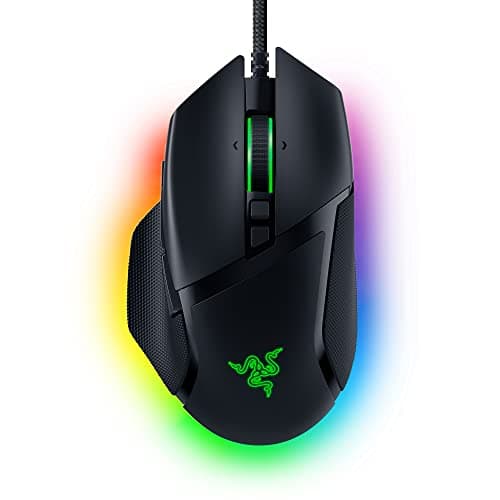
If you want buttons and a wider body, the Logitech G502 Xis 131.4 mm long and 79.2 mm wide with 13 controls — the widest shell here, which suits a broad hand as much as a long one. The Razer Basilisk V3 is the cheaper version of that idea, with a free-spin scroll wheel that is genuinely the thing you miss elsewhere, at the cost of 101 g.
If your main game is an MMO, the Corsair Scimitar Elite Wireless SE is the pick despite being the shortest mouse on this page, because its sliding 12-key cluster is the only thumb layout here that moves to fit you rather than the reverse. And if the budget is tight, the DeathAdder Essentialis a 128 mm shell for a fraction of the price of everything above it — heavier, older sensor, no frills, right shape.
If none of these is quite it, the two pages next door are the right next stop: best gaming mice for FPS ranks on speed and sensor rather than size, and best wireless gaming mice covers the wireless field more broadly. If you are shopping for someone else and do not know their hand size, our how to choose a gaming mouse guide is the safer starting point — and our best gaming mice for small hands page is the mirror of this one.