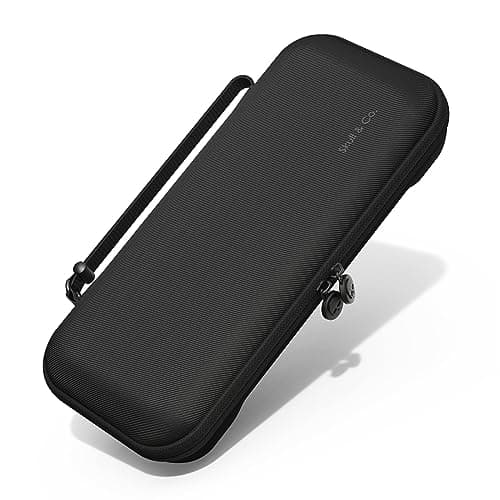
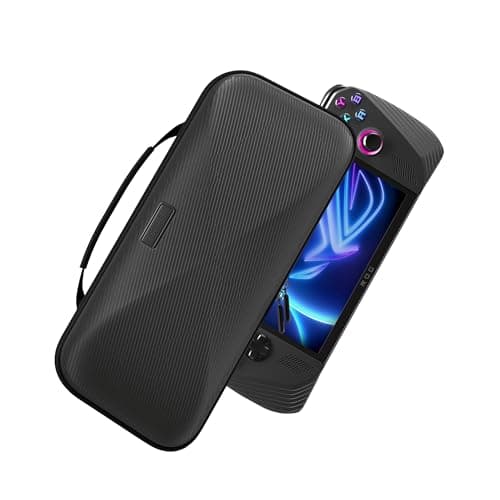
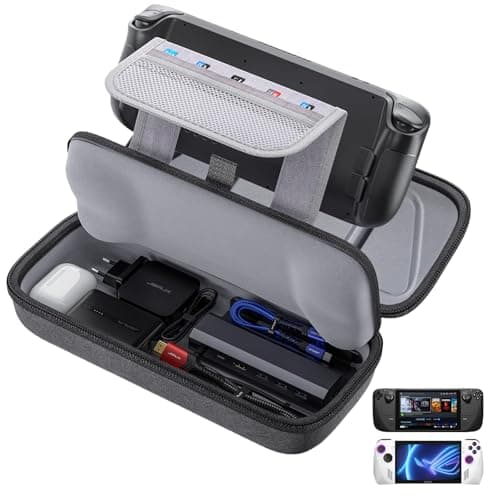
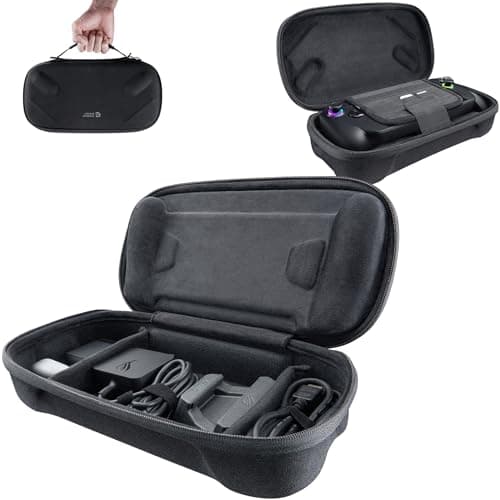
Buy the JSAUX dual-layer case. It is a proper hard shell that protects the sticks and screen against a real knock, and its second storage layer actually swallows the charger, cables and a dock — so the whole kit travels as one thing. If you carry the Ally and little else, the slimmer Skull & Co. EDC is the lighter, tidier answer; the Syntech is the value hard case when you just want solid protection cheaply.
Check your exact model before anything else."ROG Ally" is now three devices: the original Ally, the thicker Ally X, and the 2025 ROG Xbox Ally. They are not the same size, and a case molded for one may not close properly over another — the Syntech listing, for instance, warns it is not cut for the newer ROG Xbox Ally. This is the single most common cause of a returned case. Read the compatibility line on the listing and match it to the model you actually own — do not assume "Ally" means yours.
Why this is the first thing an Ally owner should buy
The Steam Deck ships with a decent carrying case in the box. The ROG Ally does not. That single fact reframes the whole category: for a Deck a case is an optional upgrade, but for an Ally it is the piece that was missing from the box, and the device is an expensive one to leave rattling loose in a bag. The sticks and the glossy screen are the parts a knock finds first, and they are the parts a case exists to guard. If the Ally ever leaves the house, a case is not an upsell — it is the purchase you make before any other.
The real decision: hard shell or slim, and how much you carry with it
Once you have matched the model, cases split cleanly into two jobs, and buying the wrong one is the usual mistake:
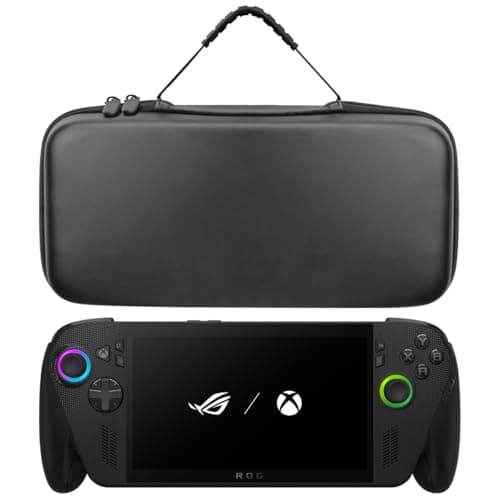
- Hard shell with storage — a rigid case that guards against drops and packs the charger, cables and even a dock alongside the handheld. This is the JSAUX and, more cheaply, the Syntech. The trade is bulk: you are carrying a box, not slipping a sleeve into a pocket. Right for the person who travels with the whole kit.
- Slim shell— a semi-rigid case that still protects the screen and sticks but keeps the profile tight, so it disappears into a backpack pocket. This is the Skull & Co. EDC. The trade is storage: there is room for an essential or two, not for a charger and a dock. Right for the person who carries the Ally and nothing else.
- Own two handhelds? The JSAUX universal case is sized to take a Steam Deck or an Ally, which is the sensible buy for a two-handheld household or anyone who might switch devices — at the cost of a looser fit than a case molded to one exact shape.
Notice that the winner and the slim pick are not really competing. They answer different questions. Decide first whether you are packing a kit or packing a handheld, and the case almost chooses itself.
Protection is what you are actually paying for
Whatever the shape, the point of the spend is the same: this is a device that cost you as much as a console and then some, and a case is the cheapest insurance against the cracked screen or snapped stick that ends its life early. A hard shell buys the most protection and the most bulk; a slim shell buys enough protection to matter in a bag while staying pocketable; the cheap Miimall proves you do not have to spend much to get a shell cut to the Ally's shape. What you should not do is carry the thing bare and hope.
The five here, sorted by the job each does
These are not five versions of the same case competing on price — they answer different questions, and the fastest way to choose is to find the sentence below that describes you:
- You travel with the whole kit — charger, cables, maybe a dock. The JSAUX dual-layer is built for exactly that, with a separate storage layer so everything moves as one. It is the default pick and the one most Ally owners are actually shopping for without realizing it.
- You carry the Ally and nothing else.The Skull & Co. EDC is the slim, tidy shell that guards the screen and sticks and then vanishes into a bag pocket. Storage is minimal by design; that is the point, not a shortcoming.
- You want solid protection for the least money. The Syntech is the value hard case — a rigid shell and a mesh pocket for the cable, at a price that makes protecting the handheld an easy yes. Just confirm the model fit, since it is cut for the Ally and Ally X rather than the newer ROG Xbox Ally.
- You own a Deck as well, or might switch. The JSAUX universal case takes either handheld, so one case covers a two-device household — accepting a looser fit than a molded case in return.
- You just want it Ally-shaped and cheap.The Miimall hard shell is cut to the Ally's outline for very little, which beats a generic pouch that lets the device slide around inside and knock against the zip.
Why the shell material is the part that actually protects
The word "case" covers everything from a rigid hard shell to a soft neoprene sleeve, and they do not offer the same protection. A hard shell holds its shape and absorbs the force of a drop or a crushed bag so the handheld does not — that is genuine drop protection. A soft sleeve guards against scratches and scuffs but folds under real impact, so it protects the finish, not the internals. Almost every pick here is a hard or semi-rigid shell for that reason: on a device this expensive, the whole point of the spend is surviving the knock that would otherwise crack a screen or snap a stick, and only a shell that keeps its shape does that job. A sleeve has its place — as a scuff layer inside a padded bag — but do not mistake one for real protection on its own. The reasonable rule: if the Ally is going anywhere it might be dropped, crushed under other things, or slung over a shoulder, buy the shell; a sleeve only makes sense when the case itself lives inside something already rigid.
How to buy a ROG Ally case
Confirm the model fit first — Ally, Ally X, or ROG Xbox Ally
This is the step people skip and then regret. The three Ally generations differ in thickness and dimensions, and a snug case cut for one will not close cleanly over another. The Ally X in particular is chunkier than the original. Before you look at anything else, read the listing's compatibility line and match it to your device by name. A perfectly good case that does not fit your model is a return, not a bargain.
Decide hard shell versus slim by what you carry, not by price
If you travel with the charger, cables and a dock, buy a hard case with a storage layer — the JSAUX dual-layer is built for exactly that, and the Syntech does a lighter version of it for less. If you carry the handheld and maybe a cable, a slim shell like the Skull & Co. EDC protects the same vulnerable parts without the bulk. The most expensive mistake here is buying the kit-hauler and then resenting the size every day because you never pack the kit.
Storage room is a real trade, not a free extra
Accessory pockets and dual layers are genuinely useful — until they are dead weight. A mesh pocket that holds the charging cable, as on the Syntech, costs almost nothing in bulk. A full second storage layer that swallows a dock, as on the JSAUX, is worth it only if you actually move the dock around. Buy the storage you will use and no more; the room you never fill is just a heavier bag.
Match the case to any grip you already run
If you have added a grip or a bulkier shell to the Ally, a slim case cut to the bare device may not close over it. This is the same trap as fitting a grip case inside a carry case on the Steam Deck: measure the Ally as you actually carry it, not as it left the box, before you buy a case cut close to the body.
Cheap and Ally-shaped beats expensive and generic
A case molded to the Ally's outline holds it still; a generic pouch lets it slide and knock around inside, which defeats the point. The Miimall proves you can get a shell cut to the Ally for very little. Spend where it buys a better fit or genuinely useful storage — not on branding or a finish you will never see once it is in a bag.
The inside matters more than the outside
A case is judged from the outside and does its work on the inside. A soft interior lining that won't scuff the screen or sticks, cut-outs that leave the thumbsticks room rather than pressing on them, and a cradle snug enough to stop the handheld sliding are what separate a case that protects from a case that just looks the part. A rigid shell with a hard, loose interior can still let the device rattle against its own case — so read the interior description, not just the drop-proof marketing on the outside.
Weight and bulk are a cost, so don't over-buy the box
A hard case with a full storage layer is heavier and larger than a slim shell, and that weight is with you every day, not just on the days you pack the charger and dock. If you rarely carry the extras, the kit-hauler is dead bulk you resent — and the slim EDC protects the same vulnerable parts for less to carry. Buy the protection you need and the storage you will actually use; a case is only doing its job if it is the one you keep reaching for rather than the one that stays home because it is too big.
Buy it before the first trip, not after the first scratch
Because the Ally ships with nothing, the window where it is most exposed is the first few weeks — the exact time people are still deciding whether they "need" a case. They do; the case is cheap and the screen is not. Treat it the way you would a screen protector: a day-one purchase that removes a whole category of regret, not something to add once the damage is already done.
What not to pay for
"Universal" cases when you own one specific model — a molded fit protects better. Premium finishes on a case that lives inside a backpack. Storage layers for accessories you leave at home. The whole value of a case is fit and protection; everything else on the listing is decoration.