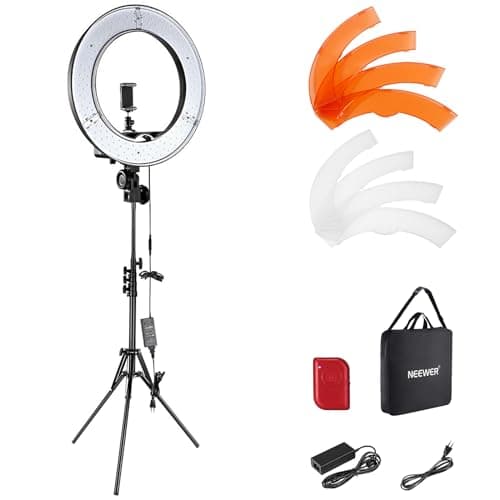
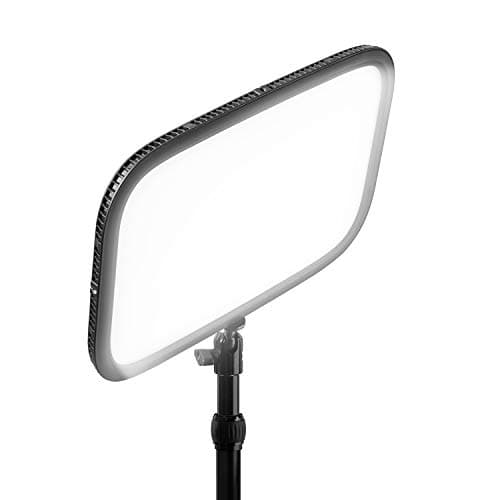
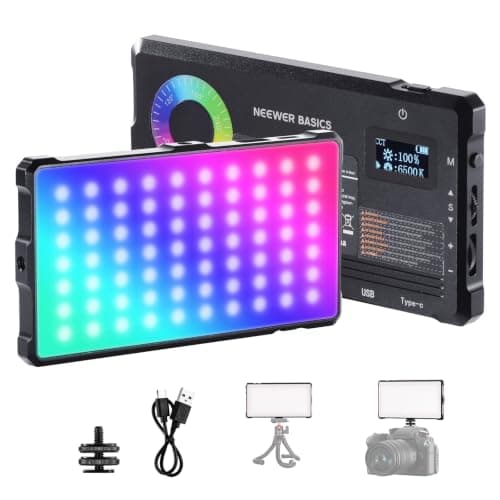
Buy a panel light if you wear glasses on camera, if your desk is shallow, or if you want your face to have any shape to it. Buy a ring light if you want the cheapest possible soft, even, shadow-free light and you have floor space in front of the desk. That is the decision, and it comes from geometry rather than from specs.
Both are LED lights. Both come in bi-color versions, both quote a CRI figure, and at the same price they produce roughly comparable amounts of light. The difference that actually changes your picture is shape and placement: a ring is a circle that has to sit around or behind the camera, pointing straight at you, and a panel is a rectangle you can put anywhere.
What a ring light does, and why the shape matters
A ring surrounds the lens, so its light arrives from every direction at once from the camera's point of view. The result is an almost perfectly even wash with no visible shadow anywhere on your face. For a presenter who wants to look clean and uncomplicated with zero setup effort, that is a genuinely good outcome, and it is why ring lights took over the beginner market.
It has two consequences people discover after buying. The first is that shadowless also means shapeless: shadow is what gives a face depth on a two-dimensional image, and front-on light flattens you. The second is the catchlight — the reflection of the light in your eye. A ring light leaves a distinct circle in each eye, which is how you can identify one on any stream within a second. Whether you mind that is taste; it is not adjustable.
And the real deal-breaker: glasses. A light directly in front of you reflects off the lenses straight back into the camera as a bright visible circle. There is no setting that removes it, because the geometry is the product. If you wear glasses on camera, this one fact settles the question.
What a panel does, and the 45-degree rule
A panel is a rectangle on a stand or a clamp, so you can place it off-axis — and off-axis is where a key light belongs. The standard placement, and the basis of the three-point lighting arrangement every studio uses, is roughly 45 degrees off to one side of the camera and slightly above your eye line, angled down toward your face.
That position does three things a ring cannot. It puts a soft shadow down one side of your face, which is what makes a face look three-dimensional. Being above eye level sends the under-chin shadow downward and out of frame instead of up your face. And being off-axis means glasses reflect the wall, not the light. Our how to light your stream guide is the longer treatment of placement, including why the ceiling light is usually the real problem.
The cost of a panel is that it demands a decision. A ring light has one correct position and you cannot get it wrong. A panel has an infinite number of positions, most of which are worse than the ring. If you will not spend ten minutes aiming a light, a ring light will genuinely serve you better.
Softness: size and distance, not wattage
Soft light comes from a physically large source relative to the subject, and it is the single biggest lever on how flattering a light is. An 18-inch ring is a large source. A 6-inch panel is a small one, and it makes harder-edged shadows at the same brightness.
Two ways to close that gap for free. Move the panel closer — a small panel at 50cm is effectively a much bigger source than the same panel at three metres, so the same light softens just by moving. Or bounce it: aim the panel at a white wall or ceiling beside you and let the wall become the source. A bounced cheap panel produces softer light than an expensive one aimed straight at your face, and it costs nothing.
This is also why wattage is a poor shopping metric. More output lets you work further back or overpower a window; it does not make the light softer or more flattering.
Color temperature and CRI, briefly
Bi-color means adjustable warm-to-cool, and it is the one feature worth paying for. Cameras handle any single consistent color temperature well and mixed temperatures badly, because white balance is one global setting. If your room has warm bulbs and your light is fixed at 5600K daylight, your skin tone is unresolvable. A fixed-daylight ring light is fine in a daylight room and a problem in a warm one.
CRI is the color rendering index, and higher means colors look closer to how they would under natural light. Treat a quoted figure as a manufacturer claim — NEEWER and Elgato both publish ratings, and nobody independently audits them at this price. Low-CRI light makes skin look subtly wrong in a way viewers notice without being able to name.
Desk reality: the part that decides it for most people
An 18-inch ring light on a 71-inch stand needs floor space in front of your desk, and it will be in your way. A panel on a desk clamp or a monitor arm takes no floor at all. In a small room, a shared room or a bedroom corner, that is frequently the whole argument, and it is the reason we rank a clamped panel above a ring on our best lighting for streaming page despite the ring being the softer source.
So: what to buy
Glasses, a small room, or you want your face to have shape: a bi-color panel. Start with the cheap rechargeable one; it will change how your camera looks more than any webcam upgrade of the same money.
No glasses, floor space available, and you want zero setup thinking: the big 18-inch ring. It is the softest light per dollar here, with the stand and diffusion included.
You adjust your light often, or you stream on a schedule: the app-controlled clamped key light, where brightness and temperature are a button rather than a ritual.
A tight desk where placement is the constraint: the compact panel with the readout, so you can reproduce a setup instead of eyeballing it.
The full field, ranked, is on best lighting for streaming. If you are costing out a whole kit, best streaming setup under $200 puts the light in context against the camera and the microphone — and the honest order of purchase is light first, camera second, which what you need to start streaming explains.