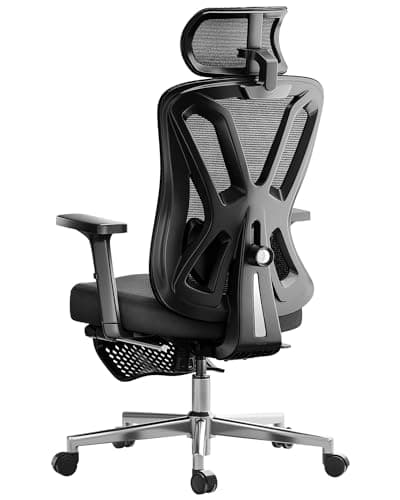
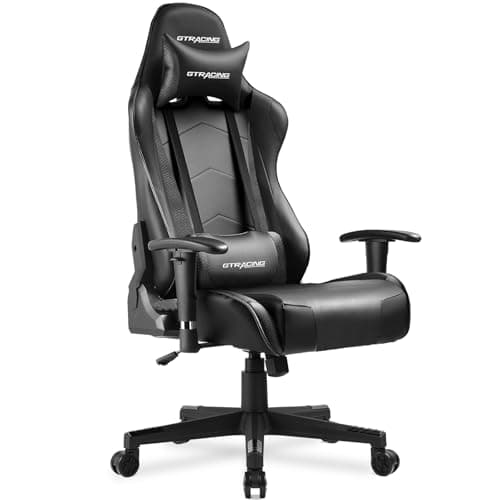
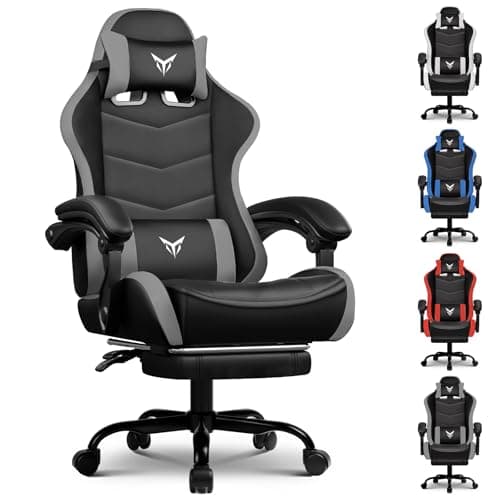
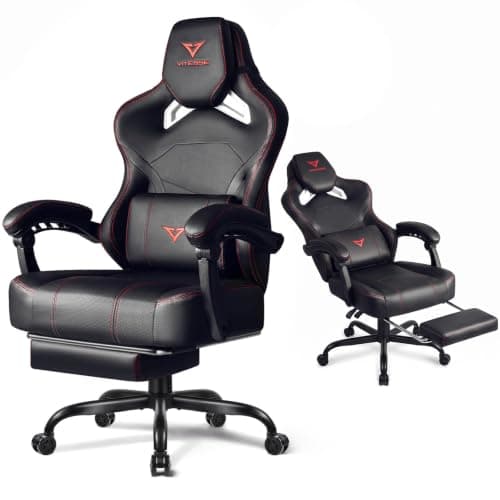
If you are over about six feet, the reason budget gaming chairs do not fit you is not build quality. It is that the seat will not rise high enough, the backrest ends below your shoulder blades, and the headrest lands on your neck. Those are three published measurements, and you can check all of them on the listing before you buy. This page ranks four chairs that pass, and tells you which measurements to read.
Seating dimensions come from anthropometric data, and volume manufacturing targets the middle of the distribution. The practical result is that a very large share of chairs under $200 are designed around a user of roughly 5ft 9in and under 300 lb — SIHOO, to its credit, publishes a recommended height range of about 5ft to 5ft 11in for the M57, which is the chair most often recommended to everybody. If you are outside that range, you are not buying a worse chair, you are buying a differently-dimensioned one.
The four measurements that decide fit
1. Seat height range. This is the one that matters most and the one most often ignored. The ergonomic target, per OSHA's workstation guidance, is feet flat on the floor with thighs roughly parallel to it and knees at about 90 degrees. For a 6ft 3in frame that usually needs a seat around 20–21 inches off the floor. Many chairs top out at 19.5. A listed range like “17–21 in” is a chair that can actually accommodate you; a single number, or a range ending below 20, probably cannot.
2. Backrest height. A backrest needs to reach at least to your shoulder blades to support your upper back. On a short backrest your shoulders cantilever off the top edge, which pushes you into exactly the rounded-forward posture the Mayo Clinic's back-pain guidance warns about. Racing-style chairs are usually generous here; compact mesh office chairs often are not.
3. Seat depth. Longer femurs need a deeper seat pan, but not an unlimited one: you want two to three fingers of clearance between the seat edge and the back of your knee. Too shallow and your thighs are unsupported; too deep and the front edge compresses the back of your knee, which is uncomfortable within an hour.
4. Weight capacity, read as a structural spec. A rating is about the gas lift, the base and the frame, not about you. The part that fails first on a cheap chair carrying real load is the base, which is why a steel or aluminium base rather than nylon is worth more than the number next to it. BIFMA is the industry body whose durability and stability tests the better brands cite; a chair that references a real test programme is making a checkable claim, and a chair that references nothing is making a marketing one.
The headrest problem nobody mentions
On most chairs the headrest is fixed, or it is a strap-on pillow. Either is designed to land behind the head of an average-height user. If you are tall, a fixed headrest frequently lands between your shoulder blades, where it pushes your upper back forward and makes the chair actively worse than having no headrest at all.
Two workable answers. Buy a chair whose headrest adjusts in height — a 2D headrest, as on the Hbada here — or buy a chair with a removable pillow and remove it. Both are better than living with a bolster in the wrong place, and the second is free.
Mesh or padded, at this height
Mesh breathes and padded PU leather does not, which matters more the bigger the body in the chair: more surface area, more heat, and a four-hour session in a warm room is where you notice. Mesh also transmits more of the frame, so a mesh seat pan feels firmer. Padded racing-style chairs win on recline angle — a listed 170 degrees is close to flat, and nothing mesh does that — and lose on breathability and on lumbar support, which is a pillow on a strap rather than a block that moves.
If the chair is for eight hours of desk work plus gaming, prioritise adjustment and breathability. If it is for controller sessions on a sofa-adjacent desk, prioritise recline. Our best gaming chairs under $200 page ranks the wider field on that basis, and best gaming chairs for back pain is the page to read if the reason you are shopping is that your back hurts.
What a chair cannot fix
One honest caveat, because the alternative is selling you a chair for a problem it does not solve. If your desk is too low, no chair helps: raising the seat to the right height puts your knees into the desk, and lowering it to clear the desk drops your feet off the floor. Tall users hit desk-height limits as often as chair-height limits, and a keyboard tray, a riser or a sit-stand desk is sometimes the real purchase. Our desk setup guide covers the surrounding geometry, and how to choose a gaming chair is the step-by-step version of the four measurements above.
Every capacity, recline and dimension figure on this page is the manufacturer's own published rating, not something we measured. Confirm the numbers on the exact listing and colour variant you are buying — several of these chairs list different dimensions across variants, and that is a real trap rather than a theoretical one.