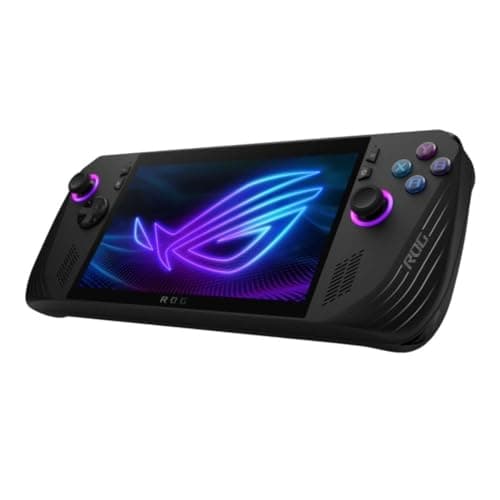
Buy the Steam Deck OLED unless a game you actually play is blocked on Linux. In that case, buy the ROG Ally X, and accept that you are buying a small Windows PC with the rough edges that implies.
A pricing warning before anything else. Both handhelds are frequently sold on Amazon by third-party resellers rather than the manufacturer, at prices well above what Valve and ASUS charge directly. The live prices shown on this page are the current Amazon listing prices — they are real, and they may be considerably more than you need to pay. Check Valve's own store (Steam) and ASUS directly before buying either of these from a marketplace listing. We earn a commission on Amazon links and we are still telling you to look elsewhere first, because that is the honest advice.
The real difference is the operating system, not the chip
Every comparison of these two devices leads with the silicon: the Ally X's Ryzen Z1 Extreme is faster than the Deck's custom APU, and it wins on frame rate in demanding games. That is true, and it is close to irrelevant for most buyers.
The thing you will actually feel, every single day, is what happens when you press the power button. On the Steam Deck, the game suspends and resumes — instantly, reliably, mid-mission. On a Windows handheld, sleep is still Windows sleep: sometimes it works, sometimes the game has lost its audio device, sometimes you are looking at a desktop and a mouse cursor you have to poke at with a thumbstick.
That single behavior is the difference between a console and a laptop, and it is the reason the slower machine is the better handheld.
Where the Ally X genuinely wins
- Anti-cheat. This is the decisive one. Several major competitive games do not run on Linux because their anti-cheat refuses to. If your main game is one of them, the Deck is simply not an option and no amount of SteamOS polish fixes that.
- Raw frame rate. In heavy titles, the Ally X pulls a real lead.
- Game Pass and other launchers. They work natively on Windows. On the Deck they range from awkward to unworkable.
- The 120Hz screen.Higher refresh than the Deck OLED's 90Hz.
Where the Deck wins
- Suspend and resume. The headline feature, and Windows still cannot match it.
- Battery life at comparable settings.
- The Verified/Playable badge system, which tells you whether a game will work before you spend money on it.
- No Armoury Crate.The Ally's control software is the single most complained-about part of owning one.
- The OLED panel in a dark room.
How to decide in two minutes
Open ProtonDB and look up the five games you actually play most. If they are all Gold or Platinum, buy the Steam Deck — you will get the better handheld and you will lose nothing. If one of them is Borked because of anti-cheat, and you are not willing to stop playing it, buy the Ally X.
That is the whole decision. Everything else is a rounding error next to it.
What we could not verify: we have not run frame-rate benchmarks on either device. We do not have a lab. The performance ordering above reflects the published silicon specifications and the consistent, documented consensus of outlets that do run benchmarks — we are not going to dress that up as our own measurement.
If this comparison has pushed you toward the Ally, the next question is whether it is the right buy on its own terms rather than relative to a Deck. Our is the ROG Ally worth it guide answers that one directly, including the Windows-on-a-handheld caveat.