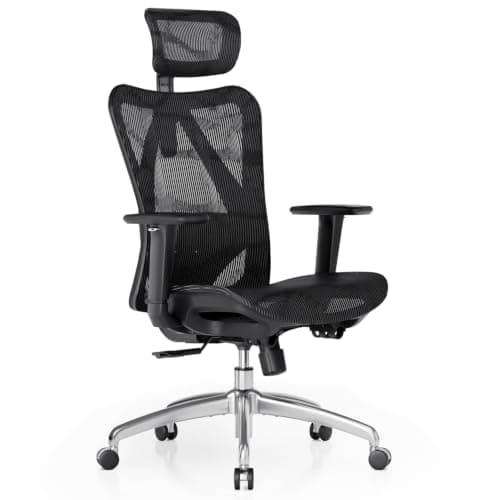
Buy the SIHOO M57. Its lumbar support adjusts in two axes — height and depth — which is the single adjustment that determines whether a chair supports your spine or just presses on your back somewhere, and almost nothing else at this price offers it. If you need to recline with your feet up as well, the Hbada P5 is the alternative.
We should be clear about what this page is and is not. We are not clinicians, we have not tested these chairs against anyone's spine, and no chair treats a back problem. What a chair can do is change how your body is loaded for the six hours you sit in it, and some chairs are much better at that than others for reasons you can read off a spec sheet. That is the whole scope of this page. If your pain is persistent, severe, radiating down a leg, or new and unexplained, the useful next step is a clinician and not a shopping page.
The one adjustment that separates these chairs
Your lower spine curves inward. Supporting that curve means putting something behind it at the right height and at the right depth — and both numbers are personal, because torso length and the depth of the curve vary enormously between people.
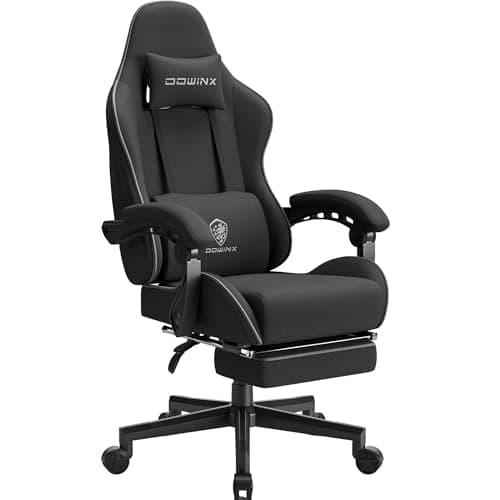
Almost every chair marketed for gaming under $200 answers this with a cushion on an elastic strap. A strap-on pillow can be moved up and down, roughly, and it cannot be adjusted for depth at all; it is as thick as it is. For some people that happens to be right. For most it is either not enough support or too much, which is how you end up with a chair that is uncomfortable in a way you cannot name.
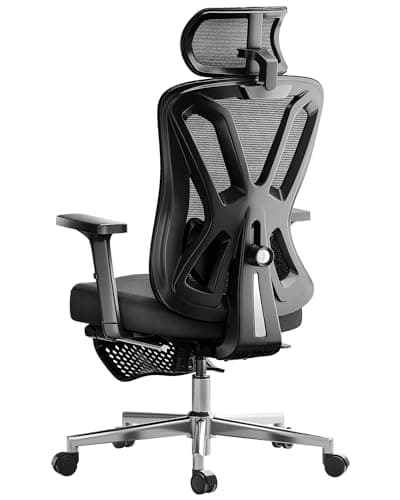
A proper lumbar block is a rigid pad on a mechanism that slides vertically along the backrest and pushes forward and back independently. You set it once, it stays. The SIHOO M57 and the Hbada P5 both have one; the two chairs below them do not, which is the main reason they rank where they do despite being comfortable chairs.
Armrests are a back feature, not an arm feature
This surprises people. If your armrests are too low, your shoulders hang and your upper back takes the load all evening. If they are too high, your shoulders shrug. Either way the tension ends up in your neck and upper back, and you blame the backrest.
What you want is your forearms roughly level with your desk surface, elbows at about a right angle, shoulders relaxed — which is exactly what OSHA's computer workstation guidance asks for. That requires armrests that adjust in height at minimum, and ideally in width and pivot too (“3D” or “4D”). Linkage armrests that travel with the backrest, as on many cheap racing-style chairs, are good for reclining and bad for this, because they are not independently height-adjustable.
Seat depth, seat material and heat
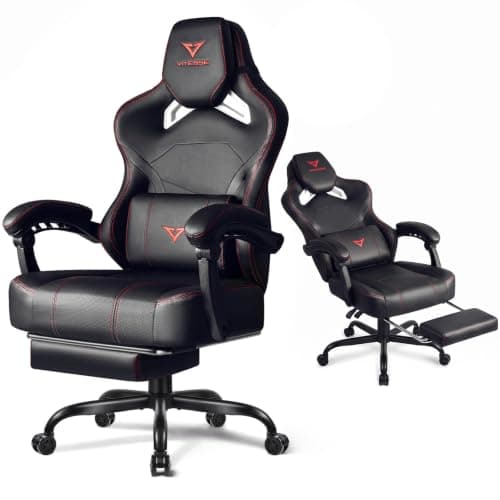
Depth.You want two to three fingers of gap between the front edge of the seat and the back of your knee. Too deep and the edge presses behind your knee, or you slide forward and lose contact with the backrest entirely — which cancels out whatever lumbar support you paid for. Too shallow and your thighs are unsupported. This is the main reason a chair that is right for a 5'4" player is wrong for a 6'3" one, and it is why we rank a big-and-tall chair here despite its weaker adjustment: a chair you fit in beats a better chair you do not.
Cushion. Flat-compressed foam is the most common long-term failure in this price band. A pocket-spring cushion, as in the Dowinx, distributes pressure the way a mattress does and resists bottoming out. A mesh seat pan is firmer and breathes better but transmits more of the frame.
Heat. PU leather traps it; mesh and fabric do not. Heat is not a spine issue, but it is the reason people shift and fidget, and a fidgeting player is a player who is not sitting in the position they adjusted the chair for.
What the ratings on the listing mean
Weight capacity, recline angle and seat dimensions on these listings are manufacturer claims. We have not loaded, measured or weighed any of these chairs and we are not going to present their numbers as our findings. Some brands cite testing against BIFMA seating standards, which are real industry durability and stability tests; that is a meaningfully better signal than an unsourced number, and where a brand claims it, we say so on the card.
One specific warning that applies to the big-and-tall category: listed recline angles and seat dimensions frequently differ between color variants of the same chair and between retailers. Confirm the spec on the exact listing you are buying rather than trusting a figure quoted in a review of a different variant.
The free changes that matter as much as the chair
Three things that cost nothing and do more than most upgrades.
Raise the monitor. A screen too low means hours of looking down, and that loads your neck and upper back regardless of how good the chair is. Our how to set up a gaming monitor guide has the height and distance figures.
Get your feet flat. If your feet dangle, your thighs carry weight they should not and you will slide forward. If lowering the chair enough to put your feet flat puts your elbows below the desk, you need a footrest, not a lower chair.
Stand up every hour. The most consistent finding in sitting research is that the duration of a static posture matters more than the posture itself. No chair out-performs getting up. Our desk setup guide covers the rest of the workspace around it.
How to choose between these four
If you want one answer, buy the SIHOO M57: two-axis lumbar, 3D armrests, mesh back. Its limitation is honest and on the card — SIHOO's own fit guidance tops out below six feet, so taller players should look at the Hbada or the VITESSE.
If you want the lean-back controller posture as well as the upright desk one, the Hbada P5 gives you a listed 135° recline and a footrest without giving up the adjustable lumbar block. If your complaint is specifically that seats go flat and hard, the Dowinxhas the best cushion here by a distance — just know that its back support is a pillow, not a mechanism. And if you are big or tall, the VITESSE Big and Tall is rated to 400 lb with a metal base, which is the hardest thing to find in this price band.
If price is the binding constraint rather than back pain specifically, our best gaming chairs under $200 page ranks the same category on value and includes two cheaper options we left off this one on purpose, because their lumbar support is a strap-on cushion and this page is about exactly that difference.