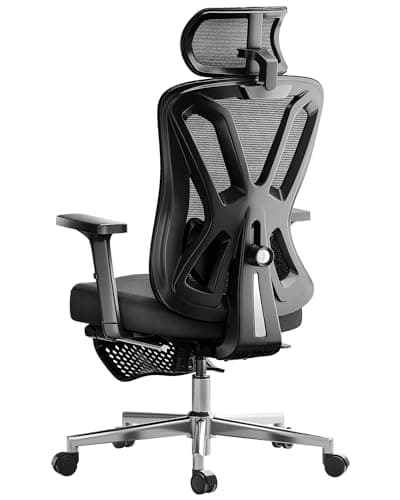
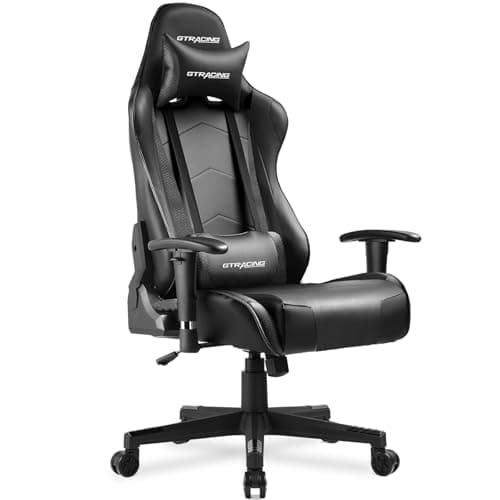
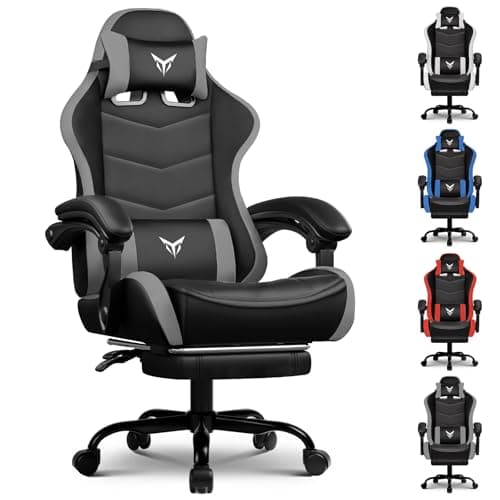
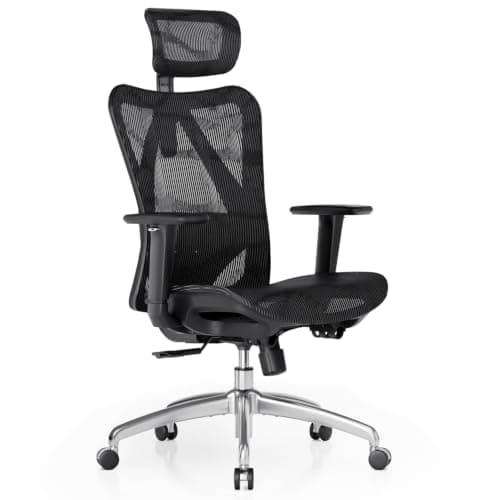
Buy the SIHOO M57. It is a plain mesh office chair rather than a racing seat, and that is precisely why it is the pick: for the same money, it gives you a lumbar support that moves in two directions and armrests that move in three, where the gaming-shaped chairs in this band give you a fixed bucket and two pillows on straps. If you want the aesthetic, the GTRACING GT002 is the honest version of it and we have ranked it third rather than hidden it.
There are only two chairs sold under $200, and almost every listing is a variation on one of them. The first is a racing-style chair: a high PU-leather back with raised side bolsters, a tilt mechanism that reclines a long way, and a headrest pillow and a lumbar pillow held on with elastic straps. The second is a mesh ergonomic office chair: a lower profile, a breathable back, a lumbar block built into the frame that you can slide and push, and armrests that adjust independently of the recline.
The racing-style formula is the one that sells, because it looks like the thing streamers sit in. The mesh formula is the one that holds up over an eight-hour day, because the two things that decide whether hour five hurts — where your lower back is supported, and where your elbows rest — are both adjustable on it and both fixed on the other. That is the whole argument of this page, and it is why the ranking looks the way it does.
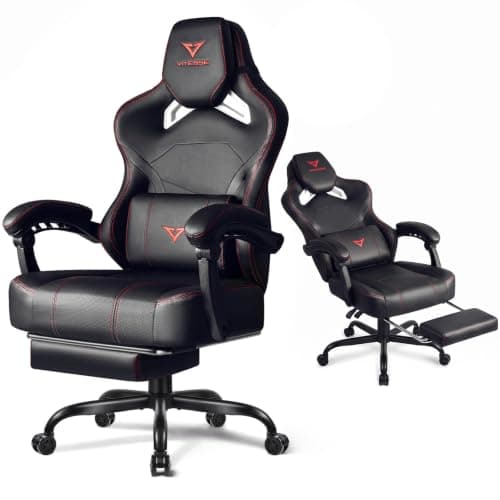
We have not sat in these chairs for a month each and we are not going to pretend otherwise. What we have done is read what each manufacturer actually commits to in writing — rated capacity, recline range, what adjusts and in how many axes, what the surface is made of — and ranked on the features that published ergonomics guidance says matter. Where a brand states a figure, we attribute it to the brand. Where brands and retailers disagree, as they do on the VITESSE, we say so on the card instead of picking the flattering number.
What $200 does and does not buy
Worth setting expectations, because the gap between this band and the one above it is larger than the price difference suggests. Under $200 you can reliably get: a gas lift with a usable height range, a recline mechanism, a 290–400 lb rated capacity, and either adjustable armrests or adjustable lumbar support. You usually cannot get all of them at once, which is what the ranking below is sorting out.
What you do not get at this price is a cold-cure molded foam seat, a mesh that stays tensioned for a decade, a twelve-year warranty, or a four-dimensional armrest. The brand-name gaming chairs sit just above the line — when we resolved prices for this page, the Corsair TC100 Relaxed and the Razer Iskur V2 X were both well clear of $200, and the RESPAWN 110 Pro was hovering just over it. If your budget can stretch past this band, those are real chairs and we are not going to pretend the ones below match them. But the single biggest comfort upgrade available to someone currently on a dining chair is any of the six here, not the step up to the band above.
One more honest note on price: this band moves constantly, and the chairs on this page are ranked on their features rather than on today's number. The prices you see are pulled live and stamped with the date they were read. A chair that sits at the top of the band one week can be out of it the next, so check the live figure before you treat “under $200” as settled.
The four things that actually decide comfort
Everything on a chair listing that is not one of these four is close to noise at this price.
- Lumbar support that moves in two axes.Your lower back curves inward, and a chair supports it only if the support sits at the height of that curve and reaches far enough forward to touch it. People's lumbar curves sit at different heights, which is why a fixed pillow works for some bodies and not others. A block that slides up/down and in/out fits everyone. This is the single most valuable feature in the band, and it is the one the racing-style chairs do not have — both OSHA and the Mayo Clinic workstation guidance put lower-back support at the center of seated posture.
- Armrests that adjust independently of the backrest.Your elbows should rest at roughly the height of your desk surface so your shoulders are not holding your arms up all session. That requires armrests with their own height adjustment. “Linkage” armrests — the kind that swing with the backrest as you recline — sound more advanced and are in fact less useful at a desk, because the one adjustment you need is the one they do not have.
- A back that breathes. PU leather is a plastic sheet. It looks good, wipes clean, and traps every bit of heat your back produces. Mesh and woven fabric both move air. In a cool room this barely registers; in a warm room during a long summer session it is the difference between comfortable and sticky, and it is the most common regret people report about cheap racing chairs.
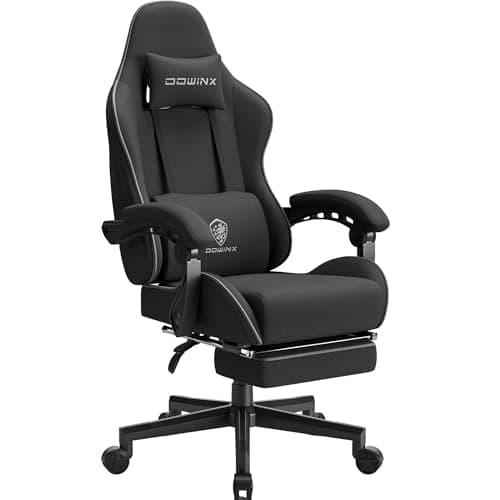
- Seat construction, not seat thickness. A thick foam pad feels great for a week and then compresses into a flat board under your sit bones. A pocket-spring cushion (the Dowinx) or a tensioned mesh pan (the SIHOO and Hbada) both distribute load rather than collapsing under it. Listings advertise foam depth because it is easy to print; it is the least predictive number on the page.
Two things that are NOT on that list and get far too much space on product pages: the recline angle and the footrest. Both are genuinely nice, and both are comfort features for the times you are notplaying. A 170° recline does nothing for your posture while you are actually at the keyboard. Buy them if you want them; do not trade away adjustable lumbar support to get them.
Weight ratings, and the one spec worth taking seriously
The rated capacity on a chair listing is the closest thing in this band to a build-quality proxy, because the parts that carry the load — the gas cylinder, the base, the seat plate — are the parts that fail. A 400 lb rating means a metal base and a higher-class cylinder; a 290 lb rating usually means nylon.
That is also why the number matters for people well under the limit. A chair rated to 350 lb and used by a 180 lb player is running its mechanism at half load, and it will outlast the same player's 290 lb chair. If two chairs are otherwise equal, the higher rating is the better buy regardless of your weight.
The surrounding certifications are worth knowing how to read. BIFMApublishes the ANSI/BIFMA seating standards — the test programs that put cycles and loads through a chair — and SGS is one of the labs that runs conformance testing. A listing that names BIFMA (the Hbada P5 does) is claiming something specific and checkable. A listing that says “heavy duty certified” with no standard named is claiming nothing at all. We rank the first kind higher and we will keep doing so.
Where the chair sits is half the problem
Worth saying plainly, because it is the cheapest fix on this page and it costs nothing. A good chair at a desk that is too high will still wreck your shoulders, because you will raise the armrests and the seat to reach the desk and lose the floor under your feet in the process.
The order that works: set the seat height so your feet are flat and your knees are at roughly a right angle, then set the armrests to your desk height, then set the lumbar block to the small of your back, then set the monitor so the top of the screen is at about eye level. If the desk is too high for that, the fix is a keyboard tray or a lower desk, not a higher chair. Our gaming desk setup and cable management guide covers the desk side of this, and what size monitor for gaming covers the screen height and viewing distance that the chair position has to work with.
The same logic runs down your arms. Once the armrests are at the right height, your wrist sits flatter and your mouse grip changes — which is why mouse size and shape matter more once your seating is right than before. If you are a larger player and your mouse feels cramped, our best gaming mice for big hands page is the companion to this one, and best gaming mousepads covers getting the surface height and area right.
How to choose between these six
Start with your height and weight, because those rule chairs out faster than anything else. If you are over about six feet, skip the SIHOO — the brand's own fit range does not cover you — and look at the Hbada P5 or the two PU-leather chairs, which have taller backs. If you are over 330 lb, the VITESSE is the only chair here rated for you, and that decides it.
Then decide which posture you are buying for. If you spend most of your time upright at a keyboard and mouse, buy adjustability: the SIHOO M57 first, the Hbada P5 if you want a headrest and a footrest as well. If you spend most of your time leaned back with a controller, buy recline: the GTRACING GT002at a listed 170° is the furthest-reclining chair on this page.
Then the room. A warm room pushes you toward the Dowinx or one of the two mesh chairs and away from PU leather, and that single factor is worth more than any spec on the listing if your setup is in a converted loft or a south-facing room.
And if none of this lands, the honest answer is that a chair is a comfort purchase rather than a performance one. No chair on this page will improve your aim. If you are weighing a chair against a monitor or a headset with the same money, the monitor or the headset will change how you play and the chair will change how you feel after four hours — which of those you need is a question only you can answer. Our best gaming monitors under $200 and how to build a gaming setup pages are where to go if the answer is “not the chair yet”.